.png)
Square Pegs Vol 8: Feeling Boxed In by Psychometrics? - Ignore the MBTI Report!
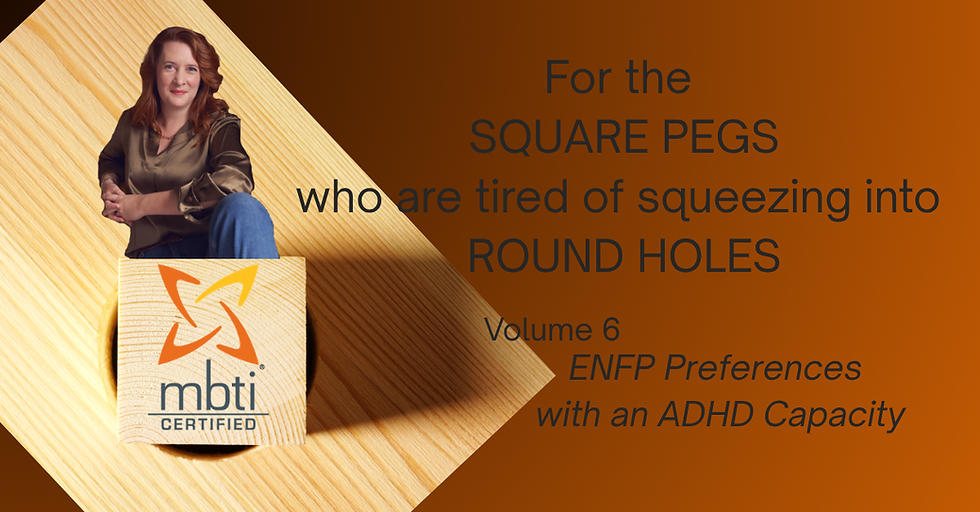
Following on from Volume 6: ENFP Preferences with an ADHD Capacity, I’ve been thinking a lot about a common piece of pushback I get when I suggest the MBTI framework to my clients:
"Sarah, I don’t want to be put in a box."
And honestly? I completely get it. As a "square peg," the last thing I want is for anyone to be handed a four-letter label, slapped with a ‘personality type’, and told to get back in that box. Unless you are my cat Emmy, who loves being in a box!
When personality tests are used to simplify us, they fail. We are far too unique, complex and layered for that.
A shift in perspective
For 15 years in corporate HR, I didn’t know I had ADHD; I just thought I was failing at being an adult. I spent those years wearing a "Professional Sarah" mask, desperately trying to write with my non-dominant hand for 40 hours a week to fit the corporate world. I won awards and looked successful on paper, but it cost me three pretty severe burnouts because I was running on empty, trying to be someone I wasn’t.
When I finally experienced a proper, facilitated psychometric exploration, things started making sense. I didn't see a list of my flaws or a box to trap me in; I saw my personality preferences, and I realised I had been spending too long forcing myself to work in the opposite way.
That personal shift opened my eyes. I trained as a Certified MBTI (Myers-Briggs Type Indicator) Facilitator. In my opinion it wasn't enough to only train with the MBTI tool. So I expanded my knowledge of Neurodiversity, upskilled in Neuroscience and Psychodynamic approaches to coaching. With this wider toolkit I thought long and hard about the way I facilitate MBTI for my clients.
A test gives you a label; a facilitated exploration gives you understanding. I don't care about the four letters on an MBTI profile report (please don’t hate me, Myers-Briggs Company!). I care about how the new awareness helps you understand your energy, drop your mask, and stop fighting your own preferences.
So how do I go about this?
These recent pieces of feedback really made me smile:
“Universally, the 1:1 sessions were incredibly helpful and valued. Sceptics who thought the framework would pigeonhole them shared how differently they experienced the reality.” Nic Allan, IPA
"It’s the first time that I have really seen MBTI come to life in this way, a huge thank you to you for your holding and enthusiasm” Leslie Brissett, IPA
As a facilitator those quotes perfectly demonstrate what I am hoping to achieve with my work.
The exact moment a box transforms into a window of understanding.
My approach is to ignore the report (to start with) and coach my client through their real-life experiences. This gives me important clues about how they prefer to be, do and behave. Layering in theory, neuroscience and the framework comes next (and it’s just as important). But doing it this way round ensures that both me, as the facilitator, and the individual can have an authentic conversation and exploration.
I find this approach creates a safe space, where people feel held and at ease as we navigate a session. I recognise it can be a daunting experience, spending dedicated time exploring personality, which is why it’s so important for me to ensure people feel comfortable and trust me, so we can have vulnerable authentic conversations together.
The MBTI assessment (and therefore reported type) is based on questions that force binary answers.
Are you this or that? But we are not this or that; we are uniquely us.
We may also find ourselves answering in the way we think we should (that professional mask playing havoc again), or we’ve had a hard day, were short on time, or distracted by life.
In my 8 years of being an MBTI facilitator, half the people I’ve worked with have left the session with a different type to their reported type (this is known as your ‘Best Fit’ type). Typically I see 1 or 2 letters are different; however, I’ve worked with people who have had 3 or even 4 letters different. It’s not just me that comes across this. Research from The Myers-Briggs Company shows a similar statistic, which proves the importance of having a facilitated exploration.
And once you’ve had your facilitated exploration and decided on your ‘Best Fit’ type, your journey doesn’t stop there. I don’t agree with 100% of my ENFP report (if you’ve met one ENFP you’ve met one ENFP, as the saying goes). In fact, the amount of reflection and alone time I need made me question my ‘E’, but when that introversion goes on for too long, I find myself craving connection, and sharing ideas with others to get my spark back.
Through research I discovered that ENFPs are considered the most introverted of the extroverted types, and when you look at the dynamics of the type you understand why. ENFPs lead with Extroverted Intuition (exploring possibilities and ideas) but also heavily rely on Introverted Feeling (for processing emotions). This is proof that facilitated discussions make a real difference to the way you feel about your type.
It’s the ongoing awareness that makes the impact, not trying to fit yourself into a report just because that’s what was generated.
I often recommend that my clients print their report, highlight the statements they agree with, disagree with, and any they are unsure about, then have a follow-up session to explore these nuances in more detail. MBTI step II and Type Dynamics are also great ways to delve into this.
Side quest: When googling how to spell ‘nuances’, Google thought I was looking for Beyoncé!
What about those clients where we can’t decide on the best fit? What if they are stuck between 2 or 3 types and resonate with bits from all of them? The question I tend to ask is… What does having the label of a type give you over the conversation and awareness we have built?
In the grand scheme of things the label itself doesn’t matter.
When we use personality profiles in the right way (according to me anyway) and embrace the nuance, they don't force us to conform. They give us deeper self-understanding and permission to stop being the most efficient "round hole", and start embracing our square edges as strengths, leading to a more enjoyable and authentic experience.
I'm curious: Have you ever felt boxed in by a personality test at work, or have you had a moment where one actually made you feel truly seen? Let me know, I genuinely read every response and keep learning from it!
Let’s Chat
I'm a People Development Consultant who champions the 'Square Pegs' in business. I work with high-achievers, unconventional thinkers and teams who are exhausted from trying to fit into traditional 'round holes'.
I cut through noise to help businesses figure out why their people are struggling. I help individuals move from just enduring their week to actually enjoying it, and guide teams on how to stop judging their differences and start leveraging them as strengths.
Whatever the problem, my aim is to help individuals and businesses embrace their 'square edges' with creative strategies and solutions that genuinely respect how different brains work.
Until next time, Stay Square,
Sarah


Comments